Catalogue · Ref. 02 / 08
1Home IoT Gateway: the bridge between KNX and connected devices
The IoT Gateway does one thing and does it well: linking a KNX installation to the world of connected devices and assistants, over a deliberately reduced scope. It is the right answer for an apartment or a small house — not for an entire villa.
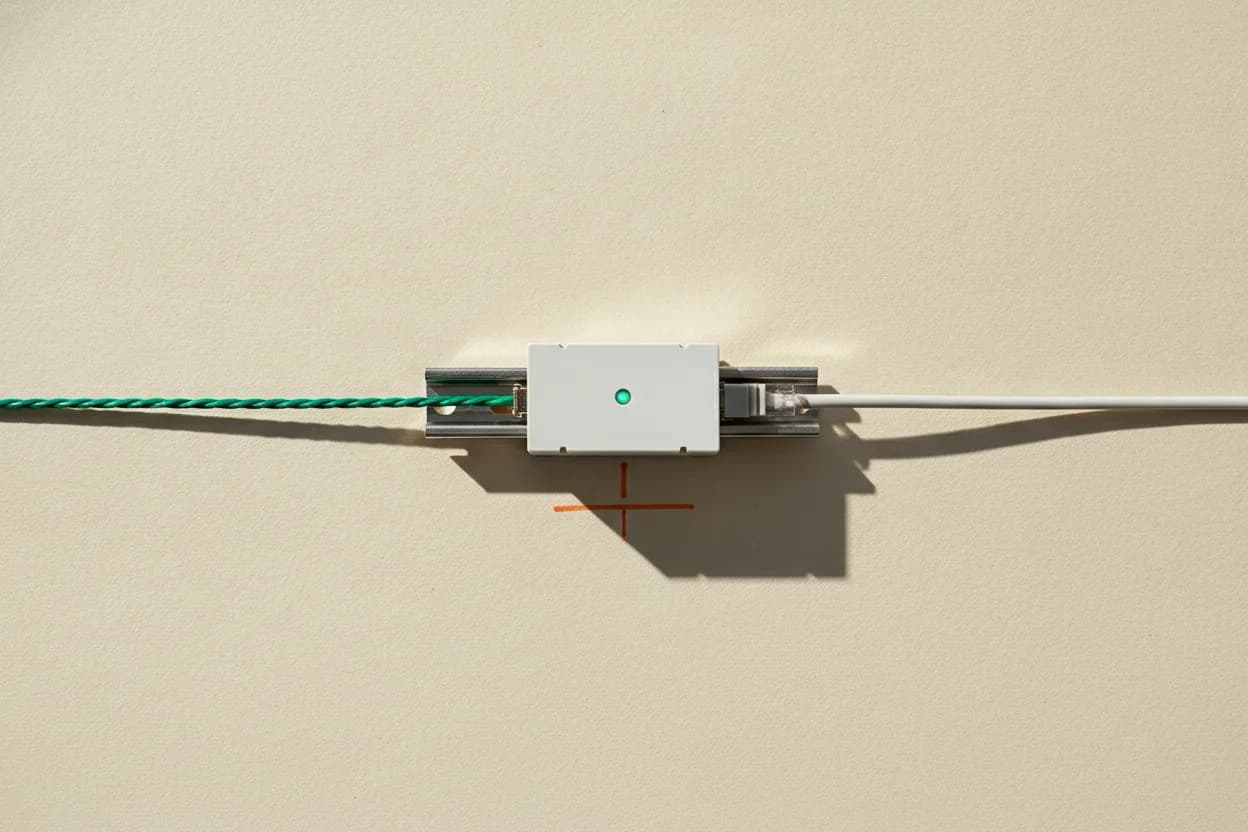
Many installations do not need a full server. A well-built KNX apartment is often a dozen lighting circuits, a few blinds and a heating control loop: oversizing it serves nobody.
This reference exists for that case. It accepts a narrower scope and a lower entry cost, with a way out: if the requirement grows, you migrate.
01What the Gateway does, and what it does not
The general rule: it bridges, it does not carry the richest visualisation layer of the range.
- It does: expose KNX objects to assistants and connected devices, remote control through the app, simple scenes.
- It does not: administer an installed base, nor cover a very large installation.
- It does not replace KNX programming: a function absent from the ETS project will appear nowhere.
02Capacity and device limits
| Characteristic | Value |
|---|---|
| Number of exposable objects | Datasheet — ask us |
| Form factor and mounting | Datasheet — ask us |
| Exposed platforms | Depends on firmware — ask us |
In practice the right reflex is not to count rooms but functions: a living room with three dimmed circuits, two blinds and a heating setpoint already makes six objects.
03Which type of home
- KNX apartment, renovation of a recent building.
- Small house with KNX limited to lighting and shading.
- Extension or outbuilding equipped separately, attached to a larger whole.
- Pilot installation, ahead of a wider deployment.
If your installation exceeds that frame, look at the Server KNX Pro instead, or go through the guided selector.
04How to know whether the reduced scope is enough
The test is a five-minute exercise: list, room by room, the functions you want to find in an app or control by voice.
- Count each separately switched lighting point.
- Add each individually driven blind or shutter.
- Add each adjustable heating zone.
- Add the switched sockets and the scenes you actually use.
The total is the real sizing criterion — far more reliable than floor area. Send it to us with your configuration file: we confirm whether this reference covers your need. Public prices are on the pricing page.
05When to step up to the full server instead
The entry-level gateway is the right answer on a limited scope. These are the signals that it is the wrong one, and it is better to see them before ordering.
- You want a visualisation interface of your own rather than the platform's app: that belongs to the full server.
- Secure remote access is part of the requirement rather than a nice-to-have.
- The installation covers a whole house with fine-grained control — dimming, blinds, per-room heating, scenes.
- You expect the perimeter to grow: extending later costs more than sizing correctly once.
None of this makes the entry-level gateway a lesser product. It makes it a product with a scope, which is what a range is for. The mistake is not buying the smaller reference — it is buying it for a job the larger one was designed to do.
Frequently asked questions
IoT Gateway or Server KNX Pro for an apartment?
For a standard apartment the Gateway is enough in most cases. The tipping point depends on the number of objects to expose and the need for advanced visualisation — we check it against your ETS project.
Can it be replaced later by a full server?
Yes. The structure derived from the ETS project remains valid; plan for recommissioning time, not a rebuild.